💉Cannulation Skills
After reading this section, you should be able to:
- ✅Apply POCUS imaging skill to locate the needle tip and target vessel in real time.
- ✅Execute Dynamic Needle Tip Positioning (DNTP) using serial short-axis views, or direct visualisation using long-axis view to track the needle tip in real time.
- ✅Recognize ultrasound signs of successful intraluminal placement or use a saline flush or longitudinal view to confirm placement.
- ✅Perform standard IV site care after the procedure.
💉Insertion Procedure
No matter short axis view or the long axis view were used, the steps of cannulation are similar. The main differences is how the needle is guided towards and into the vessel using ultrasound.
- Preparation: Position the patient and apply tourniquet. Prepare equipment, prime saline lock and sterilise the insertion site. Apply probe cover or tegaderm on top of the transducer. If the cover is not sticking to the probe well, add ultrasound gel to the interface to prevent trapping air.
- Needle entry: Align the vessel at the midline on ultrasound properly. Puncture skin slightly away from the probe, pointing at the marker denoting the midline (if available).
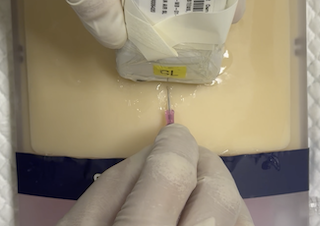
- Ultrasound guidance: Approach the anterior wall with the needle tip slowly. Use the Dynamic Needle Tip Positioning technique in short axis appraoch or direct tracking in long axis approach to guide needle movements.
- Venipuncture: Watch the tip tent the vessel wall, then pop it into the lumen. After seeing the flash back or the bullseye sign, drop the needle angle and advance 1 to 2 mm further into the vein before threading the catheter in.
- Thread the cantheter: Advance the catheter off the needle and remove the needle.
🚆Short Axis Approach
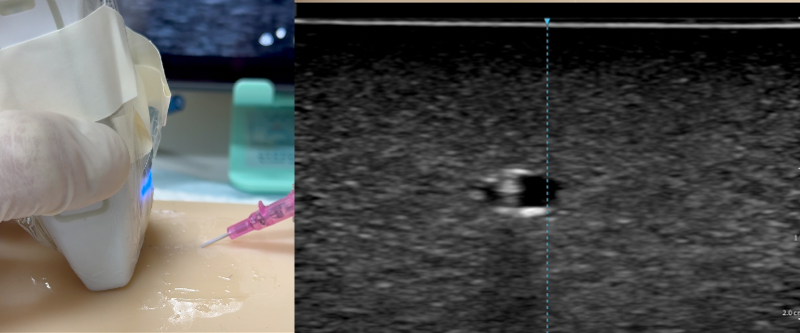
The short axis approach is also called the out-of-plane or transverse approach. The vessel and the needle tip is cut into different cross-sections images by the ultrasound beam as you slide the probe along the vessel. It provides excellent lateral resolution, but require careful step-by-step tracking of the needle tip. The Dynamic Needle Tip Positioning (DNTP) technique, also known as the “walkdown” technique or the “creep” technique is crucial in real-time ultrasound guidance with short axis view. It alternates between advancing the needle and sliding the probe. Using the short axis view and DNTP technique is easier than using the long axis view.
The DNTP Technique:
- Locate the needle tip: Insert the needle until the needle tip appears as a bright dot above the target vessel.
- Park the needle: Stop advancing the needle immediately. If the needle tip appears off from the midline, adjust the advancing direction.
- Slide the probe: Slide the probe distally until the dot disappears. Do not tilt the probe.
- Advance the needle: Move the needle until the needle tip reappears and stop immediately. The needle tip should appear closer to the vessel this time.
- Repeat: Repeat step 3 and 4, continue until the needle tip reaches the vessel wall.
- Insert the needle and locate the tip
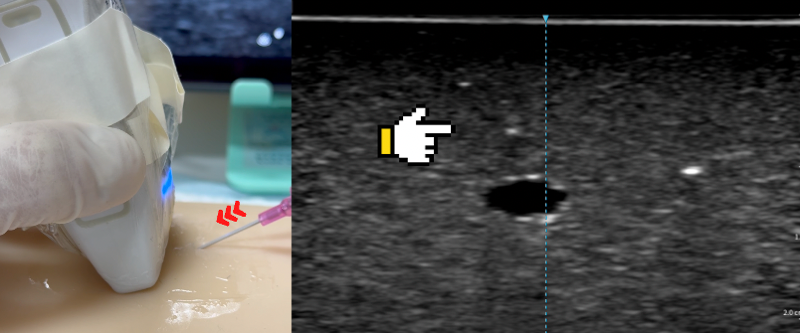
- Stop the needle and slide the probe away
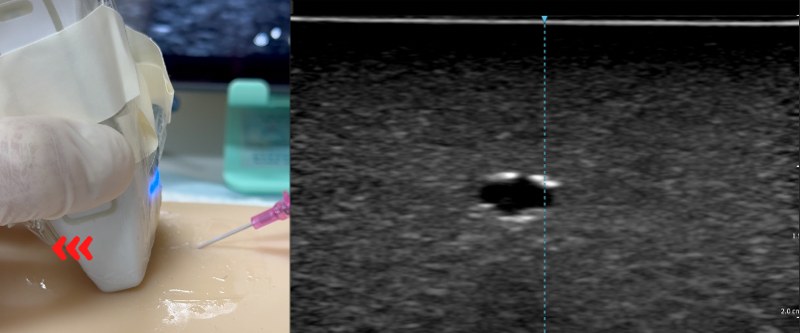
- Tent the vessel wall and pop it
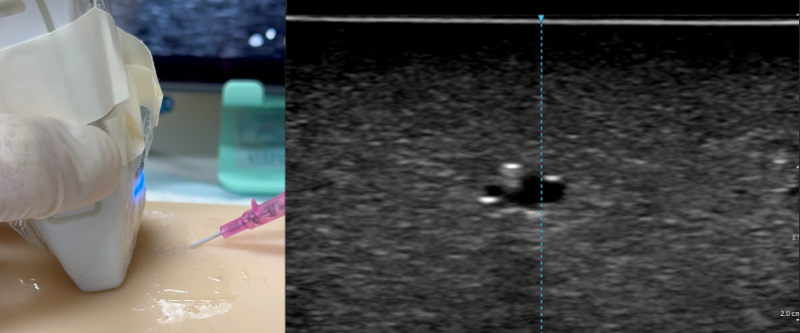
- The needle tip within vessel showing as the “bull’s eye”
🚅Long Axis Approach
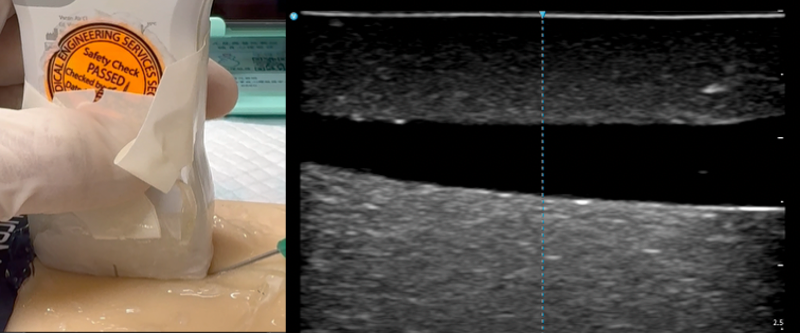
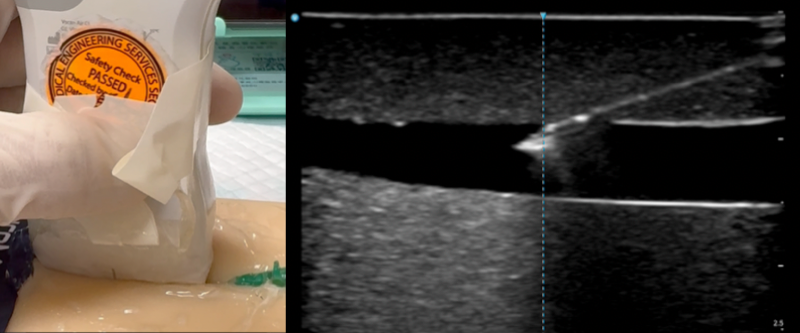
The long axis approach is also called the in-plane or longitudinal approach. As the name implies, the structures are all in-plane with the ultrasound beam. This approach is technically more demanding since one had to cut both the vessel and the fine needle along their long axis with one plane of narrow ultrasound beam. Contrary to the short axis approach, only the needle moves while the probe should remain stationary throughout the insertion. Therefore, the initial placement of the probe to obtain an optimal long axis view is crucial. This approach require precise movements and excellent hand-eye coordination. You should begin with short axis approach first. Advance to practising long axis approach only when you are comfortable with short axis.
- Insert the needle and advance slowly
- Tent and pop the vessel wall
🎖️Aftercare
- Sharps handling: Immediately dispose all sharps into the sharp box once taken out. Do not re-cap the needle.
- Verification: Connect the catheter to saline lock. Perform a 10 mL saline flush to confirm the patency. Low resistance flushing and lack of tissue swelling is an indication of successful placement. Alternatively, you may visualse the whole catheter within lumen using long axis view. You may also see the snowstorm of bubbles using POCUS while flushing saline.
- Site care: Soak away the ultrasound gel and dry the skin. Secure it with tegaderm and other dressing material.
- Documentation: Record date, time, US-guided method, gauge and length, vessel location, number of attempts, and catheter length as required by your institution.
🔄Recap
What are the four probe manipulation techniques useful for ultrasound guided IV cannulation?
The four key probe manipulation techniques are P-Pressure, A-Alignment, R-Rotation and T-Tilting.
What controls are usually available on POCUS devices to optimise scanning results?
Besides using the pre-configured presets, operators can fine tune the depth, the gain and the focus to achieve the best image. Other device settings not covered in this module include: Time Gain Compensation, Zoom, Dynamic Range and Sector Width. These settings are more advance and may not be present in POCUS devices.
How to differentiate veins from arteries and nerves on POCUS?
- They are different in terms of compressibility, pulsatility, size, shape, wall thickness and echogenicity.
- Veins are compressible, non-pulsatile, larger in size, ovoid in shape, thin-walled and anechoic. Arteries are less compressible, pulsatile, smaller in size, circular in shape, thick walled and anechoic.
- They both appear as hollow tubular structure.
- Nerves are non-compressible, non-pulsatile and variable in size. It appears as honeycomb-like echogenic bundles.